A campaign to list the building has drawn support from architects across the country.
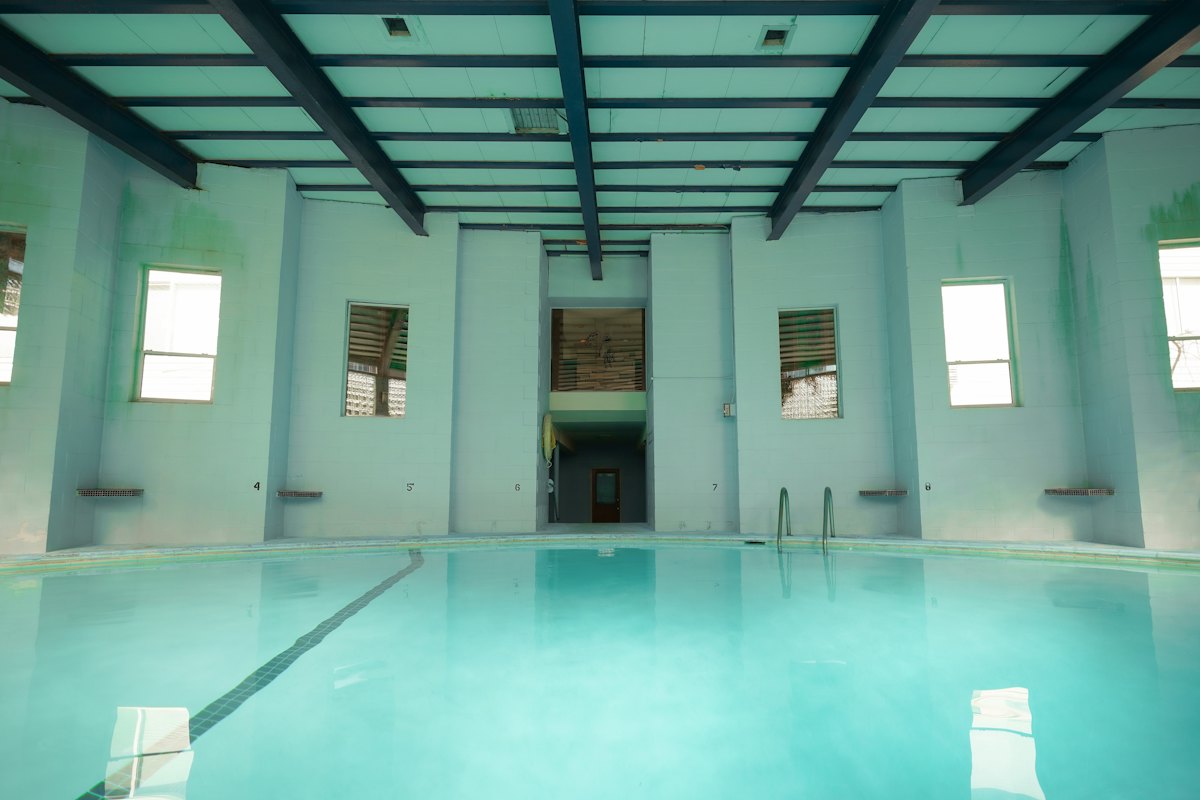
The Marine Lido on the edge of Port Selwyn has been closed since a storm cracked its seaward wall three winters ago. Its fountain is dry, its diving board has been removed for safety, and the pale green paint on its changing cubicles is peeling in long strips. Yet on Saturday morning more than 500 people stood on its terraces in the drizzle to hear speeches about why it should be saved, and the campaign to have it formally listed has now gathered the support of more than 90 architects from across the country.
The lido opened in the summer of 1937, designed by the borough engineer’s office in a streamlined style that borrowed from ocean liners: curved concrete balconies, porthole windows, a stepped clock tower and a semicircular pool fed by sea water at high tide. In its first season it drew more than 100,000 swimmers. It remained in use, with breaks for repairs, until the storm.
A building at risk
The building is owned by the harbour authority, which says it cannot afford the estimated £7.5 million needed to repair the sea wall, waterproof the terraces and replace the pumping system. In the summer, the authority invited expressions of interest from developers for the site, which occupies a prominent stretch of the promenade. Two proposals were submitted, both of which would demolish the changing blocks and replace them with apartments, retaining only the pool basin as a landscaped feature.
That prospect prompted the formation of the Friends of the Marine Lido, a group that now counts more than 3,000 members. Its application to have the building listed argues that it is one of the best surviving examples of seaside modernism in the region and that its concrete construction was technically advanced for its time. The application is supported by a letter signed by architects and conservation specialists, many of whom have never been to Port Selwyn but know the building from photographs.
“You cannot design a building like this now. The curves, the way the light comes off the water and across the tiles – it was built by people who thought ordinary townsfolk deserved something beautiful.”
The words belong to Harriet Coyle, a retired conservation architect who has written two books on interwar seaside buildings and who led Saturday’s guided tour of the terraces. She argued that the cost of repair should be compared not with demolition but with the value the building would bring if reopened, in visitors and in civic pride.
Swimmers, artists and the arithmetic
The campaign has drawn in an unusual coalition. Open-water swimmers, who still bathe at the slipway beside the lido every morning of the year, have organised sponsored swims and raised more than £40,000. A group of painters and photographers from the old town have staged an exhibition of images of the lido inside a disused shop on the promenade, and a local printmaker has produced a limited run of posters in the style of the 1930s railway advertisements that once promoted the pool.
Supporters have also commissioned a feasibility study from a firm of structural engineers, which suggests that the sea wall could be repaired in two phases at a cost of about £2.8 million for the first stage. The remainder could be raised over several years from heritage grants, a community share offer and a reduced commercial element – perhaps a café and small gallery in the former tea room – that would not require demolition.
The harbour authority’s chief executive, Malcolm Breck, said the board would consider any credible bid that removed the liability from its accounts. But he cautioned that previous attempts to reopen the pool had failed because running costs exceeded income, and that a listed building would be more expensive to maintain.
What happens next
The national heritage body is expected to decide on the listing application within three months. If it is approved, any demolition would require special consent, and the developer proposals would almost certainly be withdrawn. The Friends have asked the harbour authority to pause its sale process until then, and on Monday the authority agreed to do so.
On the terraces, the mood on Saturday was cautious rather than triumphant. Several older residents described learning to swim in the pool as children; one brought a season ticket from 1958. A teenager from the swimming club read a short poem about the clock tower. When the speeches ended, many of those present walked down to the slipway and went into the sea.