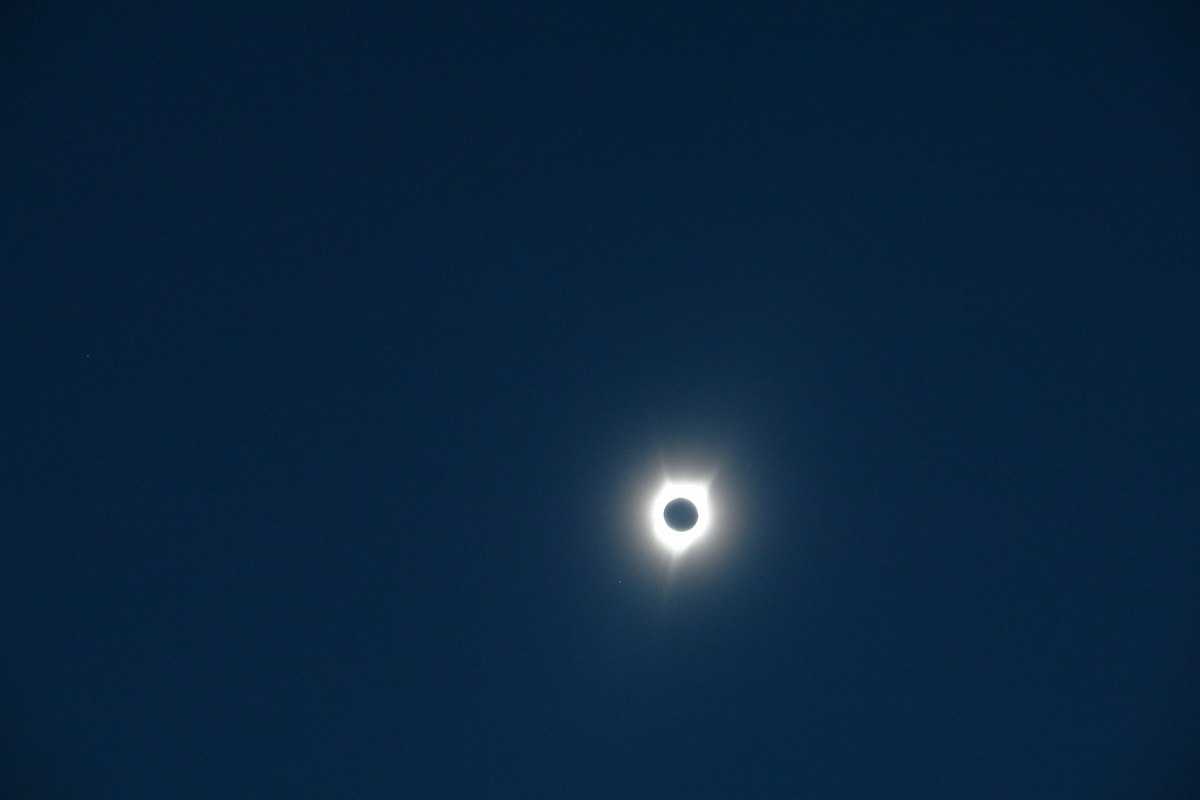
The path of totality crosses the coast for just under two minutes.
For a little under two minutes next August, the sky over part of the coast will go dark in the middle of the afternoon. The total solar eclipse – the first visible from anywhere in the region for more than eighty years – will cross the headland north of Port Selwyn at 2.47pm and move inland across Harrow Moor before passing out of the region over the hills to the east.
Astronomers at the Calder Observatory published detailed timings this week, along with a map of the path of totality, the narrow strip of ground where the Moon will block the Sun completely. Outside that band, observers will see a partial eclipse, which is impressive but not the same thing.
The path of totality
The band of complete darkness is about 95 kilometres wide. Its centre line, where the eclipse lasts longest, runs from the lighthouse at Selwyn Point through the village of Kestle Cross and on towards Harrow Light. Along that line, totality will last 1 minute 54 seconds. At the edges of the band the duration drops quickly – in central Calder, which sits near the southern edge, it will be closer to forty seconds.
- Selwyn Point lighthouse: totality begins 2.47pm, lasts 1 minute 54 seconds
- Port Selwyn harbour: 2.47pm, 1 minute 41 seconds
- Kestle Cross: 2.48pm, 1 minute 53 seconds
- Harrow Light: 2.49pm, 1 minute 37 seconds
- Calder city centre: 2.49pm, around 40 seconds
Dr Halima Rennick, the observatory’s head of public astronomy, says it is worth travelling to get closer to the centre line. “The difference between forty seconds and nearly two minutes is enormous,” she said. “With longer totality, your eyes have time to adjust, you can see the corona properly, and you might spot planets and bright stars appearing in the afternoon sky.”
“People who have seen a partial eclipse often say they have seen an eclipse. Then they see a total one and realise they hadn’t,” Rennick added. “It is the difference between a dimmer switch and someone turning out the lights.”
Picking a spot
The biggest risk is cloud. Records for August suggest the coast has roughly a one-in-two chance of clear skies at that time of the afternoon, while the higher ground of Harrow Moor fares slightly better because sea mist tends to stay below it. The observatory recommends choosing a site with a clear view to the south-west, where the Sun will sit about forty degrees above the horizon, and having a back-up location inland in case the coast is overcast.
The headland is likely to be the most popular spot, and the council has already warned that roads will be under strain. Port Selwyn expects visitors in the tens of thousands, and the harbour master is considering limiting access to the breakwater for safety. Harrow Moor, with wide open views and car parks at the two visitor centres, may be easier to reach, though rangers have asked people not to park on the verges.
How to watch safely
Looking directly at the Sun at any point before or after totality can cause permanent eye damage. Proper eclipse glasses, certified to the international safety standard, should be worn throughout the partial phases. Ordinary sunglasses, smoked glass or exposed film do not offer protection. A simple pinhole projector – two sheets of card, one with a small hole – is a safe alternative for children.
Only during the brief period of totality, when the Sun is completely covered, is it safe to take the glasses off. They must go back on as soon as the first bright point of sunlight reappears at the edge of the Moon, a moment astronomers call the diamond ring.
The observatory plans to hand out 20,000 pairs of free glasses through schools and libraries from June, and will host a public viewing event on Harrow Moor with telescopes and a live broadcast. Rennick suggests that anyone planning a trip should book accommodation now. “There won’t be another one here for most of our lifetimes,” she said. “If the clouds stay away, it will be worth every minute of the traffic.”