Built in a shed and launched from a field, it reached eighty-four kilometres.
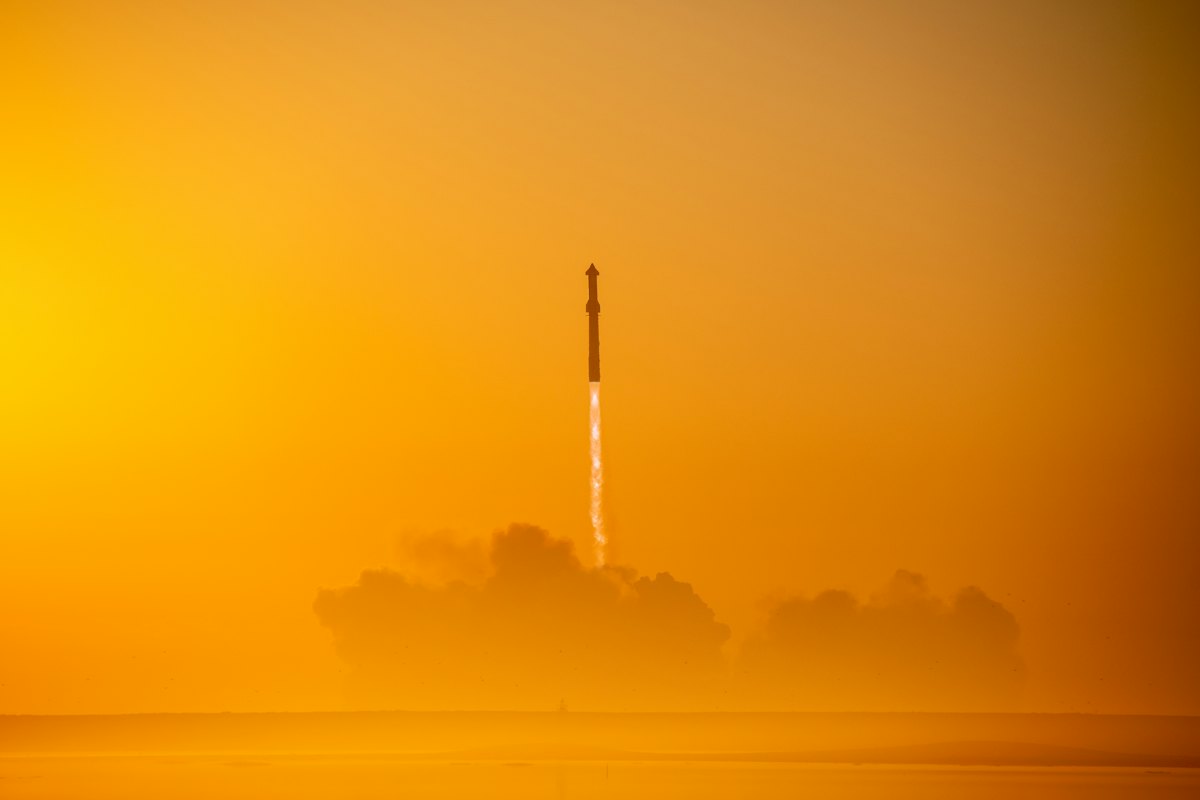
The rocket was called Heron, it was a little over five metres long, and for most of its eighteen-month life it lived in a garden shed behind a terraced house in Harrow. On a cold, clear morning last weekend, it left a sheep field on the edge of Harrow Moor at roughly four times the speed of sound and climbed to an altitude of 84 kilometres before its nose cone parachuted back to earth eleven kilometres away.
That makes it, by the team’s reckoning, the highest-flying amateur rocket ever launched in the region and one of the highest built by students anywhere. It did not quite cross the 100-kilometre line that many take to be the boundary of space, but it passed comfortably beyond the 80-kilometre mark used by some agencies, and reached an altitude where the sky above the onboard camera turned almost black.
A shed, a field and a lot of paperwork
The project began as a final-year engineering assignment at the University of Calder. Of the original group of nine students, six have since graduated and now work on the rocket in their spare time. Most of the construction took place in the shed belonging to the parents of one team member, Priya Lindgren-Shah, who said her family had become used to carbon-fibre dust on the lawn.
The airframe was wound by hand from carbon fibre around a mould the team built themselves. The solid-fuel motor, the most difficult and dangerous part of the project, was cast and tested at a licensed facility on an industrial estate outside Ardle under the supervision of a certified engineer. The team carried out four static test firings and two smaller test flights before attempting the full launch.
“People assume the hard part is the engineering. Honestly, the engineering was the fun part. The hard part was the permissions – airspace, landowners, insurance, emergency services. We had a folder thicker than the rocket,” said Callum Achebe-Ward, the team’s flight lead and a recent graduate now working at an engineering firm in Port Selwyn.
The launch required a temporary restriction on airspace above the moor, agreed with aviation authorities months in advance, and a safety zone of several kilometres cleared of people and livestock. The farmer who owns the field, and who moved his flock for the morning, was given a front-row seat.
Seventy seconds
The flight itself was over almost before the small crowd of family, lecturers and curious walkers had finished counting down. The motor burned for just under eleven seconds, accelerating the rocket to a peak speed of around Mach 4. It then coasted upwards for more than a minute, slowing as it climbed, until it reached the top of its arc about seventy seconds after leaving the rail.
Onboard instruments recorded temperature, pressure, acceleration and GPS position throughout, and a small camera pointing sideways captured footage of the coastline, the River Ardle and, near apogee, the curve of the horizon. The data was transmitted to a ground station in a van parked at the edge of the field and stored on a recorder inside the nose cone as a backup.
The nose cone separated as planned and landed under its parachute in a boggy patch of moorland, where a recovery team in waders found it about three hours later using its radio beacon. The lower stage, which was not designed to be recovered, came down within the safety zone.
What comes next
Dr Halvard Mensah, a senior lecturer in aerospace engineering who supervised the original project, said the flight was a remarkable achievement and that the data would be used in teaching for years. “It is one thing to read about supersonic flight in a textbook. It is another to have a rocket you built telling you exactly what happened to it at sixty kilometres,” he said.
The team now has its sights set on crossing 100 kilometres. That will require a larger motor, a lighter airframe and, almost certainly, a launch site with a bigger safety zone than Harrow Moor can offer. They estimate it will take around two years and are looking for sponsors to help with costs, which for Heron came to about £38,000, largely raised through donations and small grants.
A selection of the footage from the flight will be shown at a public talk at the university next month. The nose cone, scorched and still slightly muddy, will be on display.