

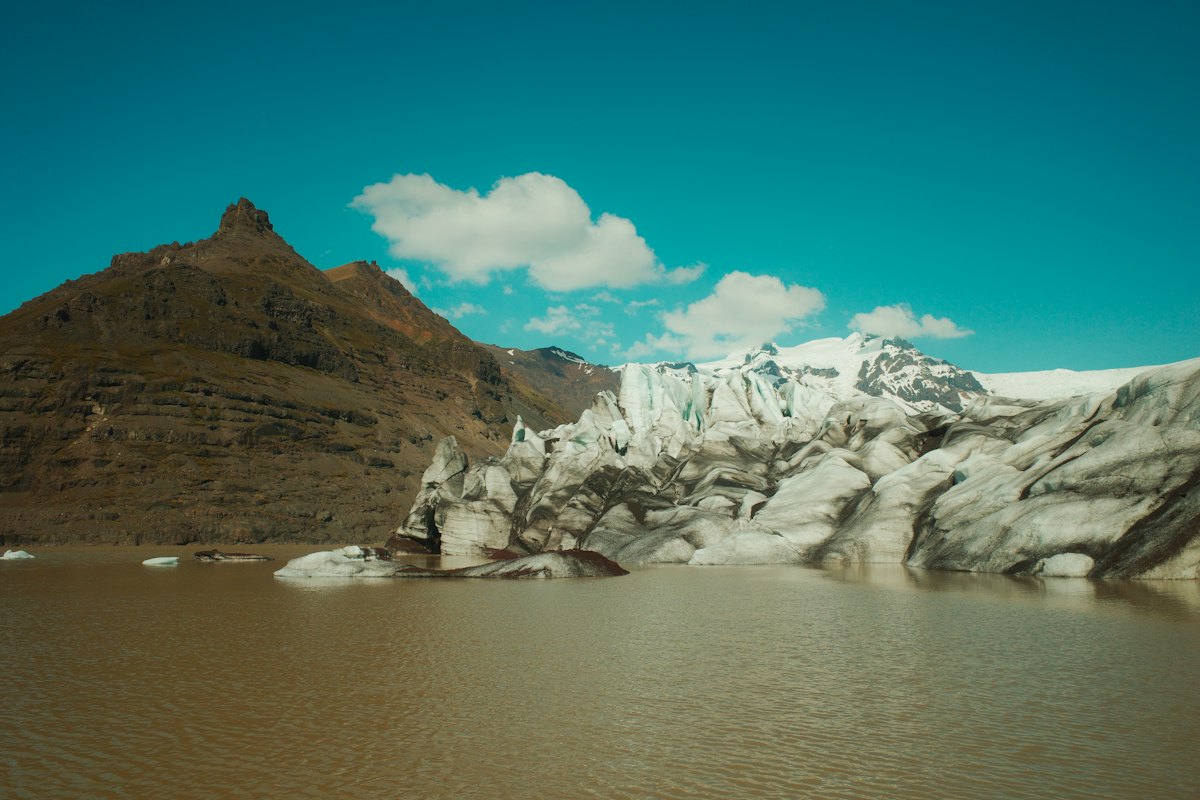
Each year the walk to the ice takes less time.
In 1987, the walk from the research hut at the head of the Stavmark valley to the snout of its glacier took a little under twenty minutes. Graduate students carried theodolites and survey poles across a stretch of gravel, crossed a meltwater stream on a plank, and stepped onto the ice. This summer, the same walk took two hours and ten minutes. The hut has not moved. The ice has.
The Stavmark survey is one of the longest continuous records of a single glacier anywhere in the northern ranges. Every August since 1971, a team from the glaciology group at Calder University has spent three weeks measuring the ice: its thickness, its speed, the position of its front edge and the amount of snow that survives the summer on its upper basin. The data now spans 55 seasons, and the trend is unmistakable.
A record measured in footsteps
The glacier’s front has retreated by about 2.6 kilometres since measurements began, with more than half of that loss occurring in the last twenty years. Its surface has thinned by an average of 48 metres at the lower survey stakes, and the area of the glacier has shrunk by roughly a third. In several recent summers, the snowline has climbed above the glacier’s highest point, meaning that no new snow survived to replenish it at all.
The walking time has become an informal shorthand for the team. Each year, a member of the survey records how long it takes to walk from the hut door to the first point where the ice can be stepped on safely, carrying a standard load. The figure is unscientific, but it captures something that charts struggle to convey. Students who were not born when the first walking times were noted now spend half a morning simply reaching the ice.
“My supervisor used to say we would know the glacier was in trouble when we needed packed lunches for the walk in. This year we needed packed lunches and a tent at the halfway point.”
So said Dr Annika Brevold, who first joined the survey as an undergraduate in 1994 and has led it for the past twelve years. She has measured the glacier in every season since, missing only one year when she broke an ankle on the moraine.
What the ice leaves behind
As the glacier retreats, it uncovers a landscape that has not seen daylight for centuries. The ground between the hut and the ice is now a field of grey rubble and fine silt, dotted with small lakes that fill each summer and drain in autumn. Mosses and lichens arrive within a few years of exposure; willow shrubs within a decade. Ecologists working alongside the survey have mapped the progression of plant life across the newly exposed ground, using the glacier’s past positions as a natural clock.
The retreat also changes the hydrology of the valley. Meltwater flows have increased as the ice thins, feeding the river that runs down to the fishing villages on the fjord. Hydrologists expect that pattern to reverse within the next two or three decades, as the glacier becomes too small to supply large volumes of summer meltwater. For the villages, which depend on the river for hydropower and fish runs, that tipping point matters far more than the glacier’s length.
There are practical changes too. The survey team has had to relocate its weather station twice and has replaced the plank bridge with a cable crossing after the meltwater stream widened into a braided channel. Survey stakes drilled into the ice now melt out by the end of each summer, so they must be redrilled every year rather than every few years.
Keeping the record going
Long-term records like Stavmark’s are rare and fragile. They depend on funding renewed every three to five years, on the commitment of individual scientists and on a steady supply of students willing to carry heavy equipment across rough ground. Twice in the last decade, the survey came close to losing its grant; both times it was saved by a last-minute award from a science foundation and a fundraising appeal among former survey members.
The team is now trialling drone surveys and satellite data to supplement the ground measurements, which could reduce the need for long walks. Brevold says the stakes and the footsteps will continue regardless. The point of the survey, she argues, is that it has always been done the same way, and comparisons only mean something if the method does not change. Next August, someone will again set off from the hut door with a stopwatch.