





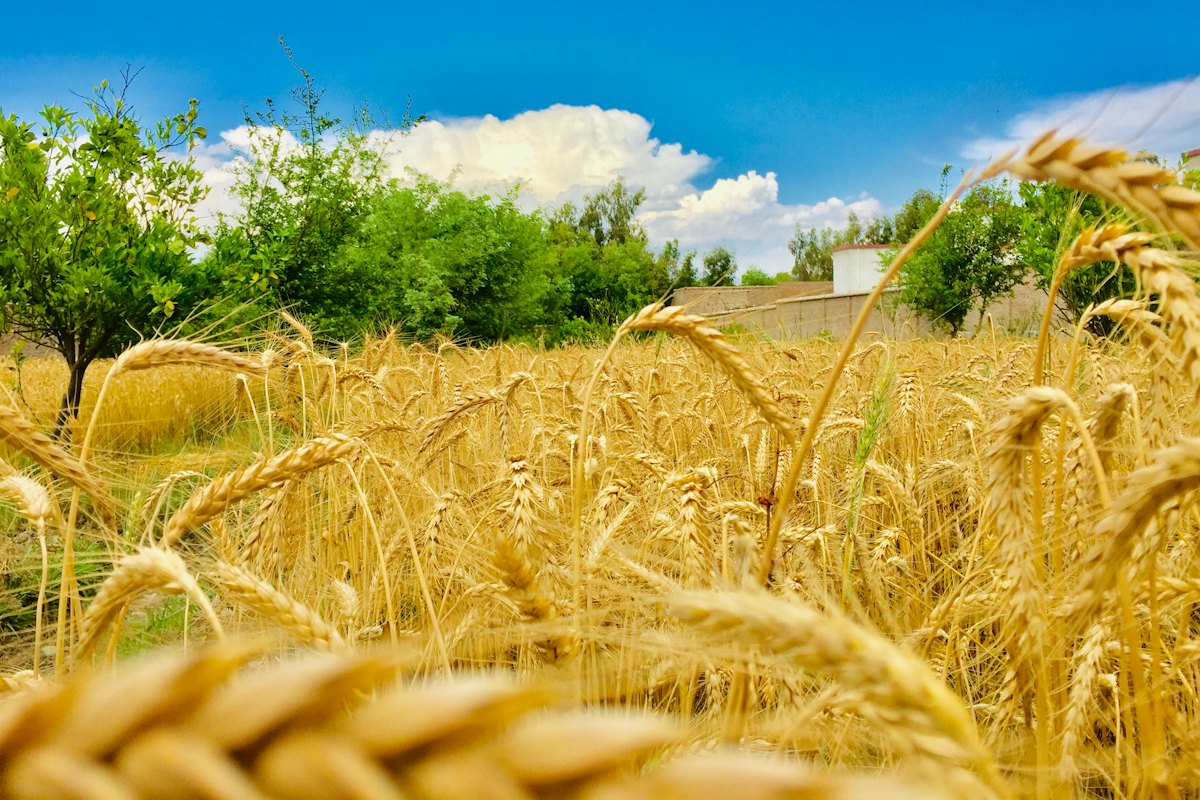
An old wheat variety is being grown again in the valley.
The field at Langdon Farm, on the south-facing slope above the River Ardle, does not look like modern wheat. The stalks stand nearly chest-high, the ears are long and bearded, and when the wind comes up the valley the whole crop moves like water. This is Ardle Red, a variety that was grown across the valley for most of the nineteenth century and had all but vanished by the 1960s.
This year, five farms in the valley grew it on a combined 42 hectares, and its flour is now turning up in the bread of at least nine bakeries in Calder and the hill towns. It is not cheap – the flour costs about twice as much as a standard strong white – and the yields are a fraction of what a modern variety would produce. But bakers say it does something that ordinary flour cannot.
From a seed bank drawer
The revival began with a single envelope. Eight years ago, the agronomist Clare Whitlow came across a reference to Ardle Red in a nineteenth-century farm ledger and traced a sample to a national seed collection, where around 200 grains were stored in a cold vault. She was sent twenty. Those were sown in pots, then in a garden bed, then in a strip at the edge of a field, multiplying each year until there was enough to drill properly.
“For the first three years I was basically a gardener with a very anxious hobby,” Whitlow said. “One bad slug night could have ended the whole thing. Now there is enough seed held by five farmers that it would take a real catastrophe to lose it again.”
Ardle Red is tall, which makes it prone to falling over in heavy rain, and it needs less fertiliser than modern wheat – too much, and it grows even taller and collapses. Growers say its deep roots cope well with dry spells, and it competes strongly with weeds. Langdon Farm grows it without synthetic sprays.
The grain is milled at the restored water mill at Fennick, on the Ardle, which reopened as a working mill three years ago. Stone-grinding keeps more of the germ and bran in the flour, giving it a speckled, creamy-brown colour and a sweet, slightly nutty smell.
What it is like to bake with
Bakers who use it describe a flour that is weaker than modern bread flour, absorbing less water and producing a softer, less elastic dough. Most blend it – typically 30 to 50 per cent Ardle Red with a stronger flour – though some make an all-heritage loaf for customers who want it. For home bakers who manage to get hold of a bag from the mill shop, the Fennick miller suggests this simple loaf:
- 300g Ardle Red stone-ground flour
- 200g strong white bread flour
- 340ml lukewarm water
- 10g salt
- 5g dried yeast (or 100g active sourdough starter, reducing the water by 50ml)
Mix the flours and water and leave for 30 minutes before adding the salt and yeast; this rest lets the bran soften. Knead gently for about eight minutes – the dough will feel slacker than usual – then leave covered for two hours, folding it over itself twice in the first hour. Shape into a round, place seam-side up in a floured basket and prove for about an hour, or overnight in the fridge for a deeper flavour. Bake in a lidded pot preheated to 240C for 25 minutes, then remove the lid and bake for a further 15 to 20 minutes at 220C until the crust is deep brown and the base sounds hollow. Let it cool fully before cutting.
Price, and the question of scale
At the Old Town Bakehouse, a half-and-half Ardle Red sourdough sells for £5.20, compared with £4 for its standard loaf. The owner, Ravi Chandrasekar, said customers were happy to pay more once they had tasted it, but admitted that supply was the limiting factor. “We could sell three times as much if we could get it,” he said. “Some weeks the mill tells us there is none until Thursday.”
Growers are wary of expanding too fast. The variety is low-yielding – Langdon Farm harvested about 3.5 tonnes per hectare this year, against more than eight for a modern wheat on the same ground – and its value depends partly on its scarcity and story. There is also the risk that a big buyer arrives, demands volume and drives the price down.
For now, the plan is modest: another two farms will sow it this autumn, and the mill will add a second pair of stones. Whitlow, who still keeps a few grains of the original sample in a jar on her kitchen shelf, says she is happy to go slowly. “It disappeared once because nobody thought it was worth the trouble,” she said. “I would rather it grew back properly than quickly.”