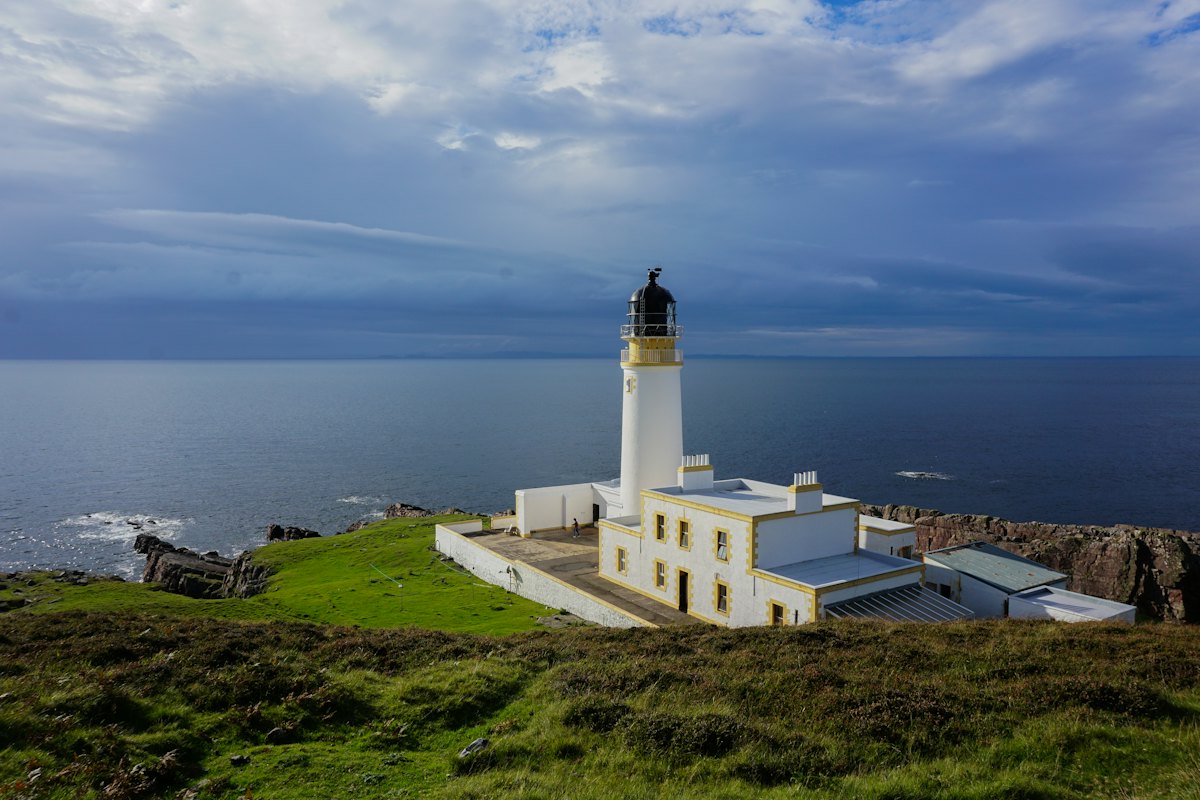
The lamp has been automatic for decades. Someone still climbs the stairs every evening to check on it.
At a quarter to five on an October evening, with the light going grey over the headland and the wind coming in hard from the west, Alun Petheridge unlocks the iron door at the foot of Harrow Light and begins to climb. There are 117 steps. He has counted them, he says, perhaps fifteen thousand times.
The lighthouse on the rocks below Harrow has not needed a keeper since 1987, when its lamp was automated and the last full-time crew left. Its beam is now controlled by a sensor that switches it on at dusk, and any fault is reported automatically to a monitoring centre many miles away. And yet every evening, in all weathers, someone still climbs the tower to make sure. For the past nineteen years, that someone has been Petheridge.
A job that officially does not exist
Petheridge, who is 71, is not employed by the lighthouse authority. He is a volunteer “attendant”, a role that exists in only a handful of places along the coast, paid a nominal annual fee to carry out basic checks, report problems and keep an eye on the building. His father was an assistant keeper here in the 1960s, and he spent part of his childhood in the cottages that cluster at the foot of the tower.
“I suppose I never really left,” he says, pausing on the landing at step 64 where a small window looks out over the bay. “When they automated it, my father said the light would be lonely. I thought that was a funny thing to say. I am not sure it was.”
The checks themselves take about twenty minutes. He looks at the lamp and the rotating optic, the great glass lens that magnifies a modest bulb into a beam visible some 18 nautical miles out to sea. He checks that the backup batteries are charged, that no water has come in through the gallery door, and that nothing has nested in the vents. He signs a logbook – a paper one, though the authority also asks him to send a text message to confirm.
Weather, and the long view
In winter storms, the climb can be unpleasant. Spray reaches the gallery windows 30 metres above the rocks, and the tower hums when the wind gusts above 60 miles an hour. Petheridge has been caught up there twice by storms that arrived faster than forecast and spent the night in the old watch room, wrapped in a blanket he keeps in a cupboard for the purpose.
He has seen things few others have: a pod of dolphins working the tide race below the headland, a fishing boat limping home with a broken rudder that he reported to the lifeboat station before its own radio call came through, and, one January night, the aurora, faint green over the northern horizon. “Nobody believed me,” he says. “Then it was in the paper.”
“The light does not need me, I know that,” he says. “But a building like this needs someone to notice it. If a gutter goes, if a window cracks, a sensor will not tell you. I am the person who notices.”
What happens when he stops
That is the question that troubles the small community at Harrow Light. Petheridge has had two minor heart operations in the last five years, and he admits the stairs are harder than they were. The lighthouse authority has said it values the attendant role but has not committed to replacing him when he retires, and several of the cottages at the foot of the tower are now holiday lets.
Ffion Treharne, who runs the café in the former keepers’ store, has started a petition asking the authority to guarantee the role and open the tower to visitors on summer weekends. More than 2,000 people have signed. “Alun is the reason this place feels alive,” she says. “When people come down the hill, they ask if they can meet him. He is part of the lighthouse now.” Petheridge is more equivocal. He would like someone to take over, he says, but only someone who wants to. “You cannot do this because you have been told to. You have to want to climb the stairs in the rain.”
By the time he reaches the top, the sensor has done its work. The lamp is lit, and the beam sweeps out across the bay in its familiar pattern: two flashes every fifteen seconds. He checks the optic, writes in the logbook, sends the text. Then he stands for a minute at the gallery window, watching the light turn. “Every night,” he says. “Still the best view in the region.”